

Artificial intelligence today is developing faster than ever before, and new research, applications, and technology have emerged nearly every day. Whether it is big language models transforming our experience of working with computers or AI achieving important breakthroughs in healthcare, robotics, and scientific research, it has become increasingly important to keep abreast of what is happening with big language models and artificial intelligence in general.
Nevertheless, such an abundance of AI-related materials may be exhausting. There is a constant stream of research papers, startups thrown all over social media, and a press cycle that comes at the speed of light in the industry. This is what makes AI newsletters so valuable: they are curated pieces and packages that cut through the noise and present the most critical developments, insights, and analyses to you via email.
It is a rigorous list of the best 10 AI newsletters that are distinguished by their quality, relevance, and unusual points of view. You may be an experienced AI researcher, a business leader who is considering implementing AI, or you may just be interested in the opportunities opened up by artificial intelligence; either way, you will not be left behind in the news!
Also read: Best WhatsApp Marketing Software
Selection Criteria of Best AI Newsletters
We have narrowed down our top AI newsletters to a number of criteria that assure quality, relevance, and value as far as readers are concerned:
Relevance and Coverage:
The AI newsletters need to cover the developments in AI thoroughly without regard to whether they are of interest to professionals, enthusiasts, and learners. This covers breaking news, new research findings, industry trends, and real-world applications.
Frequency and Consistency:
Regular delivery schedules help readers stay consistently updated. Our preference is for newsletters with stable publication frequencies: weekly, biweekly, quarterly, and so forth.
Quality and Depth:
The topic should exhibit careful research, excellent reporting, and critical analysis, but not mere summarizing of the topic. The finest AI newsletters provide context and interpretation to provide the readers with an understanding of the relevance of developments.
Expertise and Authority:
We prefer those AI newsletters that are written by established experts or researchers or industry professionals, who encompass trustworthy pieces of information and authoritative voices in their publications.
Readability and Engagement:
The material must be readable and deep at the same time for the intended targets. This involves clarity, rational structure, and interesting approaches to presentation.
Unique Perspective or Niche Focus:
The great newsletters provide one or more things that are special to them, whether it be a specific angle on developments in AI, coverage of specialized areas, or unique frameworks for analysis that make these newsletters stand out as compared to generic news aggregators of AI.
Top 10 Best AI Newsletters
1. The Batch by DeepLearning.AI
Website: https://www.deeplearning.ai/the-batch/
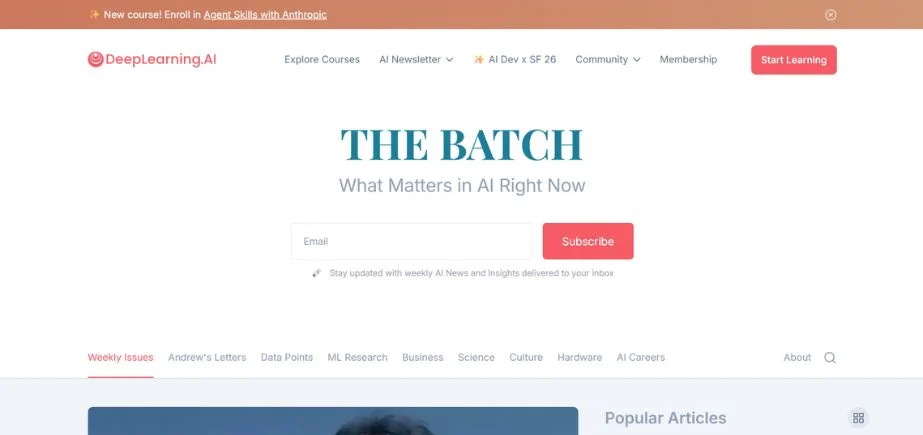
The Batch, a publication by DeepLearning.AI, created by Andrew Ng, provides a weekly brief of breaking news in artificial intelligence. It addresses research advancements, industry trends, and real-world applications, helping to understand complex topics for both professionals and hobbyists. The books are stacked with hand-selected articles, commentary, and tools and resources to ensure readers keep pace with the rapidly evolving field of AI. The Batch aims to simplify the high-impact technical developments and moments using clear explanations with eyes wide open, making it a trusted and easy-to-digest source of AI news and analysis.
Key Features:
- Weekly delivery schedule with consistent, reliable publication
- Educational approach that makes complex AI concepts accessible to all skill levels
- Comprehensive coverage of major AI developments, research breakthroughs, and industry analysis
- Practical insights that explain not just what’s happening in AI, but why it matters
- Editorial curation by Andrew Ng’s team, ensuring authoritative and accurate content
Best for:
AI practitioners, business leaders, students, and anyone seeking authoritative yet accessible AI news.
2. Import AI by Jack Clark
Website: https://jack-clark.net/

Import AI, authored by Jack Clark (Anthropic co-founder), provides profound information about recent advances in AI research, policymaking, and trends in this industry. It is a newspaper in the form of a weekly that offers insightful remarks about the novel technology, the ethical issues to consider, and the larger meaning of the implementation of AI. The newsletter integrates the technical updates and makes them accessible so that the readers can figure out both what and why something is happening. It is a staple tool for AI professionals, policymakers, and anyone interested in the role that AI is playing in the future of society and innovation.
Key Features:
- In-depth analysis of cutting-edge AI research papers with detailed technical breakdowns
- Focus on broader implications including societal, ethical, and strategic dimensions of AI
- Policy expertise perspective from author’s background in AI governance and safety
- Rigorous examination of AI developments beyond surface-level reporting
- Commentary on the future direction of AI research and its potential consequences
Best for:
AI researchers, policy makers, and professionals who want deep analysis of AI’s technical and societal implications.
3. TLDR AI
Website: https://tldr.tech/ai
TLDR AI is an AI-focused newsletter that delivers a curation of the most important news, research, and product updates in brief, easily digestible summaries every day. Specifically geared towards busy professionals, it offers respective takeaways in a minimal bullet-point form, making it not seem to have too much information. As a newsletter that covers the latest developments in research papers, startup launches, and funding, TLDR AI makes sure that subscribers can get a set of insights into what is going on in the AI world faster. It is concise, well-written, and easy to understand, which is why it can be regarded as a valuable source of information that AI enthusiasts should not miss out on.
Key Features:
- Extremely concise format designed for busy professionals with limited reading time
- Comprehensive coverage of major AI news, product launches, and research findings
- Quick-scan format that delivers key information in just a few minutes
- Regular delivery schedule ensuring consistent updates on AI developments
- Focus on practical relevance, filtering out noise to highlight truly significant developments
Best for:
Busy professionals, executives, and anyone who wants comprehensive AI updates in a time-efficient format.
4. Synced AI Technology
Website: https://syncedreview.com/
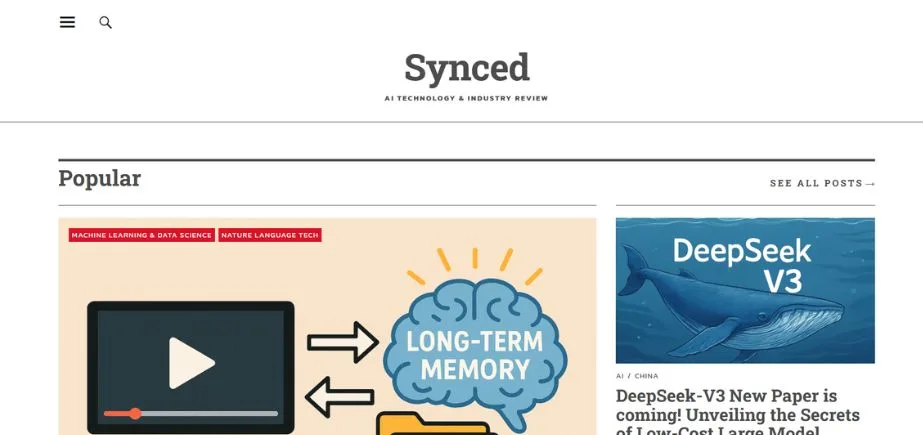
Synced AI Technology covers news in the global AI research and industry but has a particular focus on original reporting and technical detail. It puts on the floor developments around machine learning, robotics, computer vision, and natural language processing. The newsletter is commonly comprised of summaries of recently released academic articles, entrepreneur profiles, and an interview with researchers. Having established a bilingual operation in both English and Chinese, Synced AI Technology connects AI communities on both sides of the world, and thus it will be an enriching source of both localized and globalized coverage of AI innovation to the reader.
Key Features:
- Global perspective covering AI developments beyond Silicon Valley and Western academia
- Strong coverage of Asian AI markets and emerging technology hubs
- Focus on breakthrough research from international institutions and companies
- Coverage of government AI initiatives and policy developments worldwide
- Analysis of cross-border AI collaborations and competitive dynamics
Best for:
Researchers, investors, and professionals interested in global AI developments and emerging market innovations.
5. AI Weekly
Website: https://aiweekly.co/
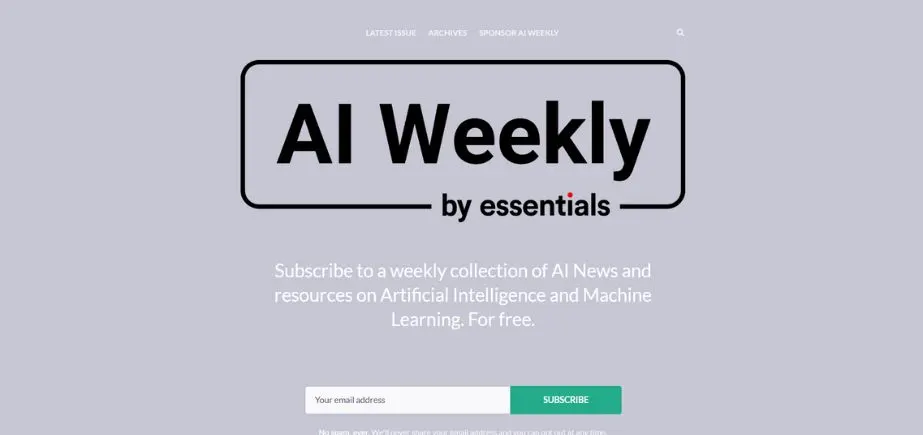
It is the place where, every Friday, you can get a roundup of the most relevant AI news, research, and opinions. It has a clean and straightforward editorial style that is easily skimmed or, alternatively, jumped into. It tries to make all the topics that have been covered very broad in terms of the coverage points, such as learning breakthroughs and ethics, among others; this makes it relevant even to the average person who does not have to be technical. Useful tools, learning resources, and news about the conferences, as well, are what the newsletter offers, so that anyone monitoring the shifting environment of artificial intelligence has it as a weekly reading.
Key Features:
- Expert editorial curation selecting the most important stories from across the AI ecosystem
- Weekly comprehensive roundup format covering diverse AI topics and developments
- Access to extensive newsletter network with specialized AI-focused publications
- High-quality article selection that filters signal from noise in AI news
- Consistent delivery schedule with reliable weekly updates on key developments
Best for:
AI professionals, researchers, and enthusiasts who appreciate expert curation and comprehensive weekly roundups.
6. BAIR Blog Newsletter
Website: https://bair.berkeley.edu/blog/
The BAIR Blog Newsletter is from the Berkeley Artificial Intelligence Research (BAIR) lab of the University of California, Berkeley. It shares research developments, technical in-depths, and opinion articles by prominent scholars in AI and machine learning. The material frequently features original papers by faculty, graduate students, and invited scholars, and it is devoted to such topics as computer vision, robotics, reinforcement learning, and natural language processing. It is crafted to satisfy the demand of readers that would like to learn about the most advanced advancements in AI, as the members of the research community themselves identify them.
Key Features:
- Authored by top AI researchers and PhD student
- Covers breakthrough research in machine learning and robotics
- Includes clear explanations of complex concepts
- Offers insight into real-world applications of research
- Free access to all articles and archives
Best for:
AI researchers, philosophy enthusiasts, and those interested in the deeper questions surrounding artificial intelligence and human-AI interaction.
7. Inside AI
Website: https://insideainews.com/newsletter/
Inside AI is one of the networks in Inside.com, a newsletter-making platform, which focuses on the latest updates in the news about AI, research progress, and startup news and activity. The editions include brief summaries, selected links, and expert opinion every now and then, so it is simple to remain up-to-date without wasting several hours to find the required information. It embraces an equal measure of technical innovations, business tendencies, and moral debate. Its fast-read format, with regular frequency, makes Inside AI ideal as a subscription offering, ideal for anyone looking to get a regular stream of AI insights delivered to their inbox.
Key Features:
- Exclusive focus on business and commercial aspects of AI development and adoption
- Coverage of funding rounds, valuations, and investment trends in AI companies
- Analysis of enterprise AI adoption strategies and implementation case studies
- Market trend analysis and competitive intelligence across AI industry sectors
- Regulatory impact assessment on AI businesses and commercial applications
Best for:
Business executives, investors, entrepreneurs, and professionals involved in AI commercialization and enterprise adoption.
8. Data Elixir
Website: https://dataelixir.com/
Data Elixir is a weekly newsletter hand-picked by Lon Riesberg and dealing with data science, machine learning, and AI. Every issue gives a curated list of articles, tutorials, tools, and job offers and allows professionals to keep themselves informed on both technology and industries. It is recognized as a quality curated publication with a balanced presentation of research breakthroughs, how-to sections, and thought leadership stories. Being an AI engineer, data scientist, or student, you should find Data Elixir a well-structured and reliable platform that offers ongoing study and career advancement.
Key Features:
- Specialized focus on the intersection of data science, machine learning, and AI technologies
- Practical tutorials and implementation guides for data professionals
- Tool recommendations and reviews for data science and ML workflows
- Coverage of data engineering innovations that enable AI applications
- Analysis of how AI is transforming traditional data science practices and methodologies
Best for:
Data scientists, machine learning engineers, analysts, and professionals working at the intersection of data and AI.
9. Superhuman AI
Website: https://www.superhuman.ai/
Superhuman AI provides information about the most significant AI news, tools, and trends to inform readers about the ways in which artificial intelligence is changing the industry. It includes brief reviews, useful hints, and, sometimes, curious, speculative essays on the influence of AI on society. The newsletter will be used to democratize AI, and thus, the technical discussion will be mixed with practice. The subscribers will receive actionable news about the hottest AI models currently, new startups, and tools that can enhance the effectiveness of work. Superhuman AI has a practical aspect that would appeal to those who are tech-savvy as well as interested newcomers.
Key Features:
- Ultra-efficient 3-minute daily format designed for maximum information density
- Practical focus on actionable AI tools and real-world implementation strategies
- Step-by-step implementation guides and tutorials for immediate application
- Regular tool recommendations with hands-on usage examples and comparisons
- Emphasis on productivity enhancement through AI tool integration in daily workflows
Best for:
Professionals seeking practical AI applications, tool recommendations, and implementation guidance.
10. The Algorithm by MIT Technology Review
Website: https://forms.technologyreview.com/newsletters/ai-demystified-the-algorithm/
A more journalistic and well-researched point of view on artificial intelligence can be found in The Algorithm, published by MIT Technology Review. Every issue explores key advances in AI, policy, and ethics, with many articles based on original reporting and interviews with experts. It describes the importance of technical innovations in an interesting and comprehensive manner, and scientific issues can be explained without being naive. AI influence on business, politics, and society is also discussed in the newsletter and provides readers with a detailed account of its trip around the world. It is a reliable, in-depth depository of AI news and analysis.
Key Features:
- Rigorous journalism standards with investigative reporting on AI implementation and impact
- Strong focus on AI ethics, bias, fairness, and responsible AI development practices
- Comprehensive analysis of regulatory developments and policy implications worldwide
- Balanced reporting that examines both AI’s promise and its potential risks and challenges
- Forward-looking analysis of AI’s long-term societal and economic implications
Best for:
Policy makers, ethicists, journalists, and professionals concerned with the responsible development and deployment of AI technologies.
Benefits of Subscribing to AI Newsletters
Quality AI newsletters can also be beneficial to keep up-to-date with the fast-moving AI world in a wide range of ways:
Time Efficiency: Newsletters will send you curated content directly to your inbox instead of you browsing through various websites, research databases, and social media. This saves you the hours you would spend researching, and you also do not lose out on new developments.
Expert Curation: The key role of newsletter writers and newsletter editorial teams is that they provide filters based on their experience to sift out the most meaningful developments amongst the thousands of articles, papers, and news announcements published each day on AI. Such expert sifting is priceless in a discipline where the information is too much.
Diverse Perspectives: Different newsletters offer unique viewpoints and focus areas. Others are technical in nature, others are aimed at business, and some are concerned with ethical and policy issues. The subscription to several AI newsletters will create a balanced picture of the AI world.
Trend Identification: Reading newsletters on a regular basis will allow you to detect new patterns and trends prior to them becoming commonplace. This prior knowledge can be vital to people taking strategic decisions or researchers who have to recognize fruitful research areas.
Networking and Community: Numerous newsletters also cultivate communities around the material, which allow them to reach out to others with similar interests in the field, other professionals, researchers, and hobbyists. Such groups may prove to be helpful in career building, networking, and information sharing.
Continuous Learning: Continuous learning is facilitated by the regular cycle of information and is of great necessity in a field where current events can easily render the knowledge old in no time.
How to Choose the Right AI Newsletter for You
The choice of the most suitable AI newsletters is based on a number of personal and professional factors:
Match Your Expertise Level: As a beginner, it is important to focus more on newsletters that clearly explain the concepts and give the needed context, like The Batch by DeepLearning AI. Newsletters with a more balanced (and thereby more accessible) technical level might be more appealing to intermediate practitioners, whereas serious experts might be attracted by publications that feature more research, such as Import AI.
Align with Your Interests: Consider your specific areas of interest within AI. Superhuman AI may be the perfect choice if you are interested in practical applications. For business implications, Inside AI could be perfect. The Algorithm published by MIT Technology Review may be viewed as an article of interest to those concerned with ethical issues.
Consider Your Available Time: Determine the amount of time you will have realistically to read. TLDR AI does the same but has longer updates with less reading time. Import AI has more analysis but takes more time to read. Subscribe to newsletters that will suit your timing and further help you keep in touch regularly.
Evaluate Frequency Preferences: Some of them like it to be updated daily to always be up to date, while others like weekly or monthly sums, which take a bigger picture. Choose newsletters in consideration of your information consumption habits and your workflow.
Think About Your Role: Your professional role should influence your choices. The executives may be interested in business-centered newsletters, researchers may be interested in technical publications, and policymakers may be interested in ethics and regulation-concentrated publications.
Try Multiple Options: Don’t limit yourself to just one newsletter initially. Sign up for a few that appear good and test them in a couple of weeks. This is because you can always unsubscribe from those that are not suited to your needs and concentrate on those that deliver the highest value.
Final Thoughts
The artificial intelligence revolution will not be possible in the future; it is already here, and its implications go far beyond the technologies, firms, and research centers. Whether it is the way we work and communicate, entire industries, or the most basic questions about the nature of intelligence itself, AI developments have an impact on practically every single aspect of contemporary life.
One can no longer afford to be in the dark over such developments, especially those working in most professions. The AI-related newsletters featured in this guide are among the most valuable sources for keeping pace with the knowledge in this fast-paced field. Each in its own way has its strengths and views, some technical deep dives, some business applications, some ethical considerations, and some practical implementation guides.
One has to be strategic when utilizing these resources in order to gain more value out of them. Begin by subscribing to two or three newsletters with as close an interest to your area and level of expertise as possible. Take time to analyze their contents, the way they write them, and how they relate to your needs. Do not hesitate to change your subscriptions according to the changing interests and needs of work.
Hopefully, you are practiced with the idea of remaining up to date with AI, not merely through the ingestion of information but in terms of the implications and opportunities, as well as preparing to navigate changes that will inevitably impact your industry and career. We are investing in being informed today, which will yield a good harvest where AI continues to transform the professional and personal scenes we see.
FAQs
1. How does an AI newsletter work?
An AI newsletter is a selected newsletter that disseminates news, research, reviews, tools, and trends pertaining to artificial intelligence. This may be daily, weekly, or monthly, with the choice being dependent on the publisher.
2. Who ought to be subscribed to AI newsletters?
Those with a keen interest in AI, whether they are scientists, developers, business executives, students, or technophiles, may all find the most value using AI newsletters to keep themselves informed without having to actively scan the news all the time.
3. Do AI newsletters cost anything?
Lots of AI newsletters have the subscription process with no monetary costs, whereas others allow premium subscriptions with unique research results, in-depth evaluations, or prior access to the material.
4. What are the differences between AI newsletters and AI blogs?
The AI blogs are web-based and make you visit their blogs to retrieve information, but newsletters are sent to your inbox daily, and sometimes they summarize several sources to save your time.
5. What AI newsletters should every beginner subscribe to?
The Batch by DeepLearning.AI, TLDR AI, and AI Weekly are all for beginners, covering understandable descriptions, pre-selected news as opposed to actually understanding and having in-depth technical knowledge.
Continue Exploring More: Top Social Media Monitoring Tools
