
The contemporary and global business environment has made corporate financial management very complex. Companies require strong solutions to manage cash flow, liquidity, and financial risk. Treasury management software has become a necessity in the current finance team as it allows the finance team to automate its operations, have a real-time view of its cash positions, and make data-driven decisions. T
hese systems facilitate the operations of a treasury by consolidating the data in a variety of financial sources, decreasing the volume of manual work, and enhancing accuracy. With businesses going international and conducting operations in various currencies, the appropriate treasury management software is essential in ensuring financial stability and as a growth initiative tool.
Also read: Top SEO Automation Tools
What is Treasury Management?
Treasury management can be defined as the strategic management of financial assets, liquidity, and risk exposure of an organization. It includes cash management, investment decision-making, debt management, foreign exchange management, and mitigation of financial risks. The main objective is the adequate liquidity provision and maximization of returns, and reduction of financial risks. The traditional manual processes in treasury management are being converted to automated intelligent work processes through modern treasury management software.
Through the use of technology, the treasury teams will be able to predict the cash positions, monitor bank accounts, improve payment efficiency, and address legal requirements. Powerful treasury management software is the central nervous system of corporate finance that bridges the banks, ERPs, and payment systems with one platform that offers a full view and control.
Why Treasury Management Software is Important
Companies that invest in treasury management programs acquire high competitive advantages in matters of financial management. Contemporary innovations to the treasury department problems are considered to solve the most pressing issues in the treasury departments globally.
- Automation: Removes manual repetitive activities and saves processing time considerably.
- Visibility: The visibility will give real-time details on global cash positions across entities.
- Precision: Reduces human mistakes in prediction and accounting activities.
- Compliance: Assures compliance with regulatory requirements and maintenance of the audit trail.
- Scalability: Dynamically supports business expansion in various currencies, financial institutions, and locations.
Pros of Treasury Management Software
Although there is an initial investment and change management involved in the implementation of treasury management software, the pros far outweigh the cons in most organizations. The services are provided in these platforms and offer quantifiable gains in operational efficiency, financial control, and strategic decision-making processes.
- Efficiency: Automates tedious treasury functions, thereby lowering manual workload.
- Integration: Is integrated with existing ERPs, banks, and payment systems.
- Forecasting: Provides more precise cash forecasts on state-of-the-art analytical instruments.
- Risk Mitigation: Covers financial risks by monitoring them.
- Cost Reduction: Reduces the cost of banking and optimizes the use of working capital.
Cons of Treasury Management Software
Although treasury management software systems are associated with so many benefits, they have some limitations that the organization must keep in mind prior to use. Being aware of these challenges will allow setting realistic expectations and preparing for the successful deployment.
- Implementation Cost: Set up and licensing may be quite high.
- Learning Curve: The staff needs training to embrace the potential of the platform.
- Complexity of Customization: Developing solutions for a unique business is time-consuming.
- Integration Problems: There could be a need for technical resources to be able to connect with legacy systems.
- Vendor Dependency: The dependency on external providers of updates and support.
Top 10 Treasury Management Software
1. Cobase
Website: www.cobase.com
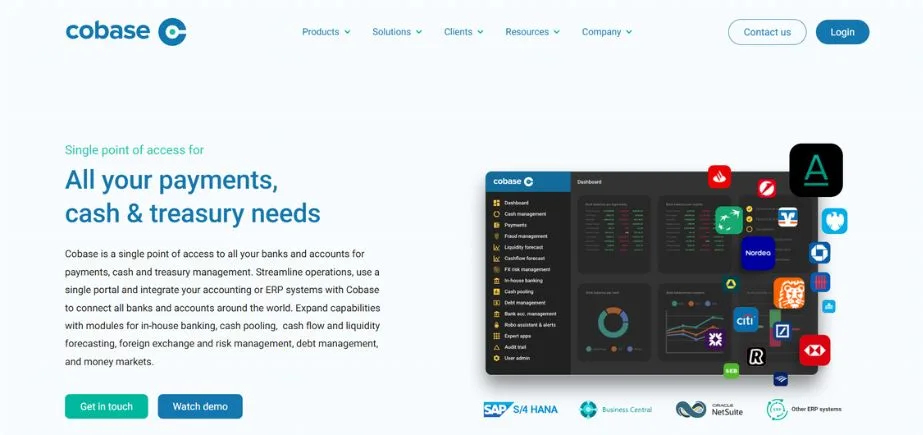
Cobase provides centralized treasury services by means of its payment hub, which is aimed at corporations that have numerous banking relationships. The platform lays stress on a secure API-based architecture, which increases compliance and fraud prevention. Robotic processes are used to automate payment approvals and execution.
Although Cobase is the most secure when it comes to multi-bank connectivity, it has a limited treasury reach when compared to full solutions. Cobase has a targeted approach that is valuable to organizations that need to pay attention to operations and bank consolidation. The treasury management software can be used by the company when the focus is on security and payment efficiency rather than on the large forecasting potential.
Key Features:
- Multi-bank dashboard
- API security
- Payment automation
- Fraud prevention
- Compliance tools
Pros:
- Secure connectivity
- Easy integration
- Fast implementation
Cons:
- Limited forecasting
- Narrow scope
- Less scalability
Pricing: Contact vendor for custom pricing
2. Kyriba
Website: www.kyriba.com

Kyriba is one of the major treasury management software vendors for large and multinational organizations. This is a cloud-based solution that provides full opportunities in cash visibility, liquidity management, and risk mitigation. The solution is very comprehensive in covering functions of the treasury and especially effective in dealing with the complex corporate structure.
Nevertheless, Kyriba is based on conventional workflows that restrict independent decision-making opportunities in opposition to AI-first solutions. Organizations value its presence all over the globe and its comprehensive risk management instruments. The financial systems are interoperable with big ERPs, which the platform integrates with using API connectors. Kyriba has continued to be successful among businesses that need well-known, fully featured treasury management software solutions that have a history of success.
Key Features:
- Cloud platform
- Liquidity management
- Risk monitoring
- ERP connectivity
- Payment processing
Pros:
- Global coverage
- Strong reputation
- Comprehensive features
Cons:
- Traditional workflows
- Complex interface
- Higher costs
Pricing: Custom enterprise pricing based on organizational needs
3. HighRadius
Website: www.highradius.com
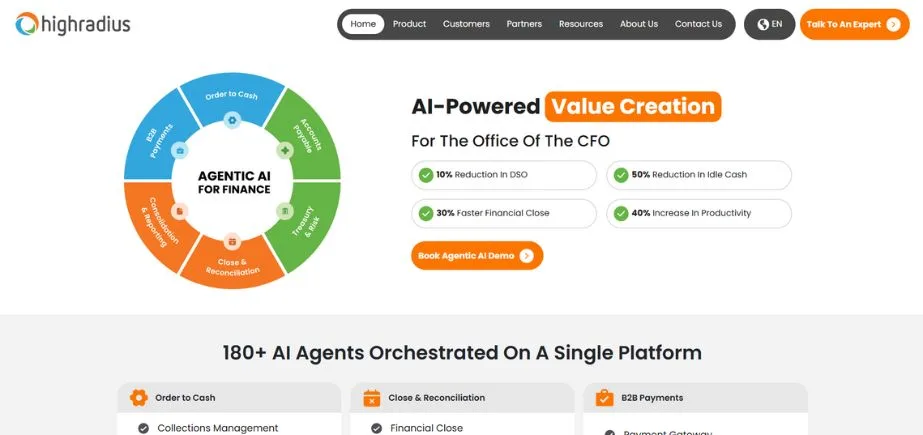
HighRadius is one of the best treasury management software solutions with both AI-driven predictions and full cash visibility and automated operations. It is also different when compared with platforms that rely significantly on manual input since HighRadius relies on autonomous decision-making and machine learning to form real-time insights. The solution also eradicates mistakes, and the scaling is seamless across multi-entity global operations.
Businesses experience up to a 70 percent increase in productivity in cash management, a 50 percent decrease in idle cash, and a 30 percent decrease in bank charges. The platform provides 95 percent accuracy of AI-driven forecasting and provides end-to-end cash visibility and payments. It is a integrator having over 50 plus ERPs, 100 banks, and 10 payment processors where the real-time treasury views are offered in an undotted form without chopped instruments.
Key Features:
- AI forecasting
- Cash visibility
- Payment management
- Multi-entity support
- Extensive integrations
Pros:
- High accuracy
- Real-time insights
- Easy scalability
Cons:
- Premium pricing
- Implementation time
- Learning requirements
Pricing: Enterprise pricing available upon request
4. FIS Treasury
Website: www.fisglobal.com

FIS Treasury and Risk Manager is one of the oldest enterprise-based treasury software in terms of management software. It has gained popularity among large corporations and financial institutions to use as a blanket cover on liquidity, payment, and risk management. The platform is end-to-end, has global payment modules, and customizable workflows in a multinational environment. Nevertheless, it is not as agile as the modern AI-powered alternatives because of its legacy architecture.
Companies that opt to use FIS usually possess significant IT resources and budgets to cover the elaborate implementations. Whereas functionality is profound and comprehensive in large-scale corporations, implementation cycles and cost structures become an obstacle in the fast-moving finance environment, which values speed and flexibility above all.
Key Features:
- Risk management
- Global payments
- Compliance modules
- Analytics reporting
- Bank connectivity
Pros:
- Comprehensive coverage
- Enterprise proven
- Deep functionality
Cons:
- Legacy design
- Complex implementation
- High costs
Pricing: Contact for enterprise-level pricing information
5. Nomentia
Website: www.nomentia.com
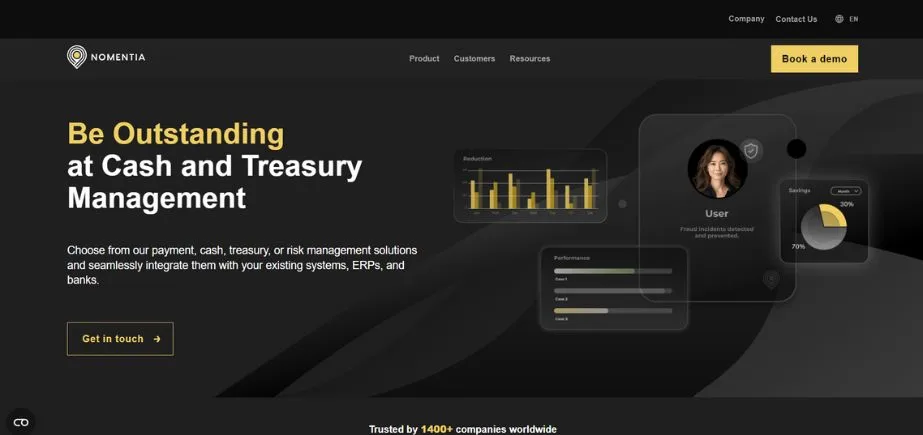
Nomentia specializes in treasury management software packages that are modular in nature, which focus on the ability to interface with a bank, prevent fraud, and provide payment hub programs and solutions across borders. The adoption is most powerful in the European market, where companies appreciate flexibility and approach targeting. It is highly modular in nature, and thus, an organization can adopt certain components according to its requirements. Nonetheless, this modularity can imply that treasuries frequently have to combine a number of tools instead of employing integrated systems.
The absence of AI-based forecasting reduces the ability to do strategic planning, in comparison to more advanced platforms. Nomentia is a good fit when companies desire customized deployments that have robust multi-bank connectivity. The solution consists of workflow automation, approval, and fraud detection instruments to aid payment compliance within different jurisdictions.
Key Features:
- Modular design
- Bank connectivity
- Fraud detection
- Payment hubs
- Workflow automation
Pros:
- Flexible deployment
- Strong connectivity
- European presence
Cons:
- Limited AI
- Multiple tools
- Integration complexity
Pricing: Modular pricing based on selected components
6. GTreasury
Website: www.gtreasury.com
Implementing the cash forecasting and modular treasury functionality of CashAnalytics has enabled GTreasury to consolidate its stance in the treasury management software systems. This growth is advantageous to businesses that are focused on the flexibility of their workflow, regulation, and increased visibility of liquidity. It is a strong platform that offers a wide range of customization features to various entity forms. But, instead of relying on AI-powered intelligence, rule-based automation makes treasury departments more operationally demanding.
Companies with large compliance needs are fond of the capabilities of the regulatory management of GTreasury. The solution assists in risk, payments, and cash management at global levels. It is modeled after multi-national corporations and provides a lot of coverage, but might need manual settings more than the alternatives that are based on AI-based best treasury management software.
Key Features:
- Modular suite
- Cash forecasting
- Compliance management
- Risk tools
- Global support
Pros:
- Highly customizable
- Strong compliance
- Multinational capable
Cons:
- Rule-based automation
- Higher maintenance
- Steeper learning
Pricing: Custom pricing for enterprise deployments
7. Anaplan
Website: www.anaplan.com
Anaplan is providing liquidity and cash management as a connected planning ecosystem, not dedicated treasury management software. Its worth is that it provides the ability to make decisions based on a scenario and cross-functional alignment on an organizational level. In the case of CFOs, it gives them planning-level visibility, but they could also need additional systems to be automated in the day-to-day running of the treasury.
The cloud platform provides stress testing of scenarios with enterprise modeling. Real-time models are helpful in the strategic decision-making process within a complex organizational structure. Anaplan has high levels of adoption of its use in enterprise-wide planning applications other than treasury. The existing users of Anaplan with planning functions may see the sense of incorporating the treasury functions, whereas the specialized execution tools may require more specific applications other than this one, that is, planning-related.
Key Features:
- Planning ecosystem
- Scenario modeling
- Stress testing
- Cloud platform
- Flexible structures
Pros:
- Strategic planning
- Cross-functional alignment
- Enterprise adoption
Cons:
- Limited automation
- Planning focus
- Requires supplements
Pricing: Subscription-based with user tiers
8. ION Treasury (Reval)
Website: www.iongroup.com
ION Treasury used to be called Reval, which is a traditional brand in the treasury management software used in multinational companies dealing with multifaceted exposures to risks. It is strong, especially in FX, derivatives, and hedge accounting, with automation embedded in the core working processes. The platform can provide end-to-end coverage of operations that are risky and have regulatory compliance and hedge effectiveness tools.
Nevertheless, the restrictions of ERP and bank integration, as well as high learning rates, are opposed to the current cloud-native alternatives. The high sensitivity of organizations to foreign exchange and derivatives is sensitive to the fully developed capabilities of ION. The solution is accessible anywhere in the world as it may be deployed in clouds and provide competitive FX management suites. Although functionality is comprehensive in specialized risk management, usability and integration tolerance are less advanced than more recent treasury management software platforms.
Key Features:
- FX management
- Derivatives handling
- Hedge accounting
- Workflow automation
- Compliance tools
Pros:
- Risk expertise
- Advanced derivatives
- Global deployment
Cons:
- Integration limits
- Learning curve
- Less intuitive
Pricing: Enterprise licensing with custom quotes
9. SAP Treasury and Risk Management
Website: www.sap.com
SAP Treasury and Risk Management is a common feature of the major treasury management software vendors because of the strong integration of the ERP in the SAP system. It provides known controlled environments to organizations that have prior investments in SAP infrastructure. The site provides sophisticated risk analytics, regulatory support, and cash forecasting and reporting dashboards. It is covered on debt, investments, and financial instruments that have strong risk capabilities.
But in a comparison of treasury management software, SAP has the advantage in SAP-centric operations, but it could be limiting to those businesses that want wider AI-based automation. There are integration issues in organizations that are not members of the SAP ecosystem. The solution is most effective with companies that are standardized to SAP and wish to have uniform treasury tools within the current technology foundation.
Key Features:
- SAP integration
- Risk analytics
- Cash forecasting
- Compliance support
- Financial instruments
Pros:
- Deep ERP ties
- Familiar interface
- Strong compliance
Cons:
- SAP dependency
- Limited flexibility
- Less AI capability
Pricing: Licensed as part of the SAP ecosystem
10. Rho Treasury
Website: www.rho.co
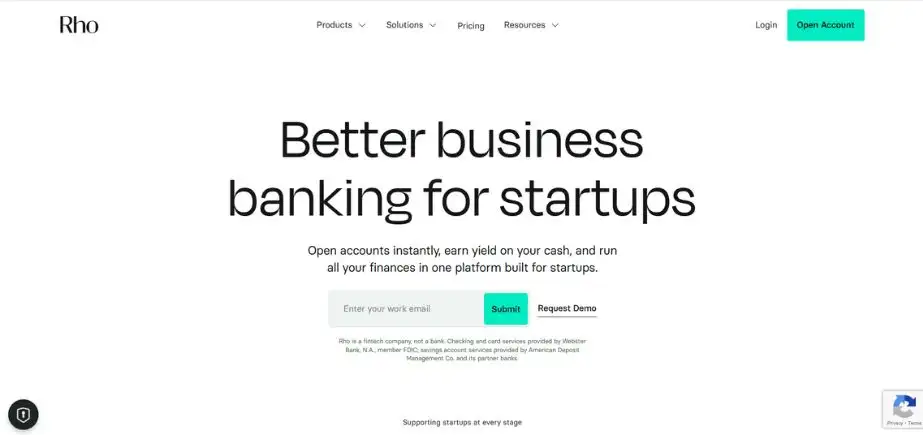
Rho Treasury provides treasury management software as part of a larger fintech solution that includes banking, accounts payable, expenses management, and corporate cards. It’s a fee model, ease of implementation, and simplicity appeal to the mid-sized enterprises and startups. The single platform automation of payment and cash tracking is of a cloud-native architecture with fintech-friendly usability. The zero platform fee is a cost-effective strategy that organizations value.
But, with the growth in the complexity of treasuries, companies might have a restricted capacity to forecast, manage risks, and support multiple entities when compared with a complete suite. Rho is extremely well-suited for expanding business with simple treasury requirements that have an emphasis on simplicity and rapid implementation. The easy implementation is such that teams that lack a lot of treasury knowledge can use it.
Key Features:
- Unified platform
- Payment automation
- Cash tracking
- Corporate cards
- AP integration
Pros:
- Fast implementation
- User-friendly
- No fees
Cons:
- Limited complexity
- Basic forecasting
- Fewer features
Pricing: Free platform with optional paid features
How to Choose the Right Treasury Management Software
The choice of treasury management software must be thoroughly determined by the local organization’s needs and the capabilities of the platform. Before an organization is committed to solutions, several factors should be evaluated.
- Scalability: This means that the platform will expand with your business in different regions.
- Integration: Check the compatibility with the existing ERPs, banks, and payment systems.
- Automation: Determine the strength of AI and machine learning to predict accuracy.
- Usability: Approach to user interface and documentation of training needs.
- Support: Evaluate the reputation of the vendor, the level of customer service, and support.
Conclusion
The application of the appropriate treasury management software can change the financial operations into strategic instead of reactive to strategic, allowing organizations to maximize liquidity, minimize risks, and enhance decision-making. The reviewed sources have different capabilities aiding in AI-enabled forecasting and automation up to oriented risk management and payment hubs.
Organizations need to match the choice of software to their unique needs by taking into account such variables as the size of the company, geographic dynamics, integration requirements, and development patterns. Regardless of focusing on highly developed AI technologies, extensive risk management tools, or a straightforward implementation, the appropriate treasury management software is available to every company.
With growing complexity in treasury operations, investments in powerful technology platforms are no longer a choice but a necessity to remain on top of the competition and financial viability in a dynamic marketplace.
FAQs
What is treasury management software?
Treasury management software automates financial activities such as cash management, cash forecasting, payment, and risk mitigation for organizations.
What is the benefit of using the treasury management software in forecasting?
The current treasury management computer systems rely on AI and machine learning to forecast the cash positions based on past data with high precision.
What are the companies that are too small to enjoy treasury management software?
All organizations, regardless of their size, gain through features of the best treasury management software differ depending on the complexity that the organization requires such software.
Is the treasury management software compatible with the existing systems?
Yes, the majority of treasury management software platforms provide the option of integration with ERPs, banking, and payment processors to operate as one.
Continue Exploring: Best Digital Marketing Companies in Delhi
